
 |
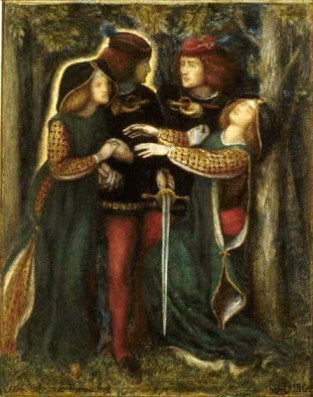
| “How They Met Themselves” (1860-64) by Dante Gabriel Rossetti |
It comes from the early nineteenth-century French term for a stereotype block, presumably due to the noise the blocks made whilst printing (clicher is a variant of the verb cliquer, to click). It existed in this literal meaning until the 1890s: the OED offers Andrew Lang, writing in Longwood’s Magazine in 1892, as providing the first usage of cliché as a metaphor meaning ‘A stereotyped expression, a commonplace phrase’. The coinage stuck, and the word cliché itself became a cliché, reproduced many times over to designate something reproduced many times over. (p. 160)

In a footnote, Macfarlane also explains the origin of ‘stereotype’:
It began as an eighteenth-century noun meaning ‘A method of replicating a relief printing surface’, but by 1850 had been abstracted to signify ‘A thing continued or constantly repeated without change, esp. a phrase or formula, etc.; stereotyped diction or usage’ (OED). (p. 160)
–
–
 Cha
Cha 